The messages reviewed offer to find customers or increase sales in exchange for a commission.
Some make large sales or revenue claims, mention extra tools, or quickly ask to move the conversation to WhatsApp.
In one example, a sender first posed a routine question about international delivery, then pivoted to a commission pitch.
The screenshots do not prove that every sender is running a scam. They do show unsolicited offers that need checking before you share access or pay for anything.
A percentage of sales can take a much larger percentage of your actual profit.
A marketplace contract may give you a formal payment or dispute process, but it cannot guarantee a refund.
What are commission-only Shopify offers?
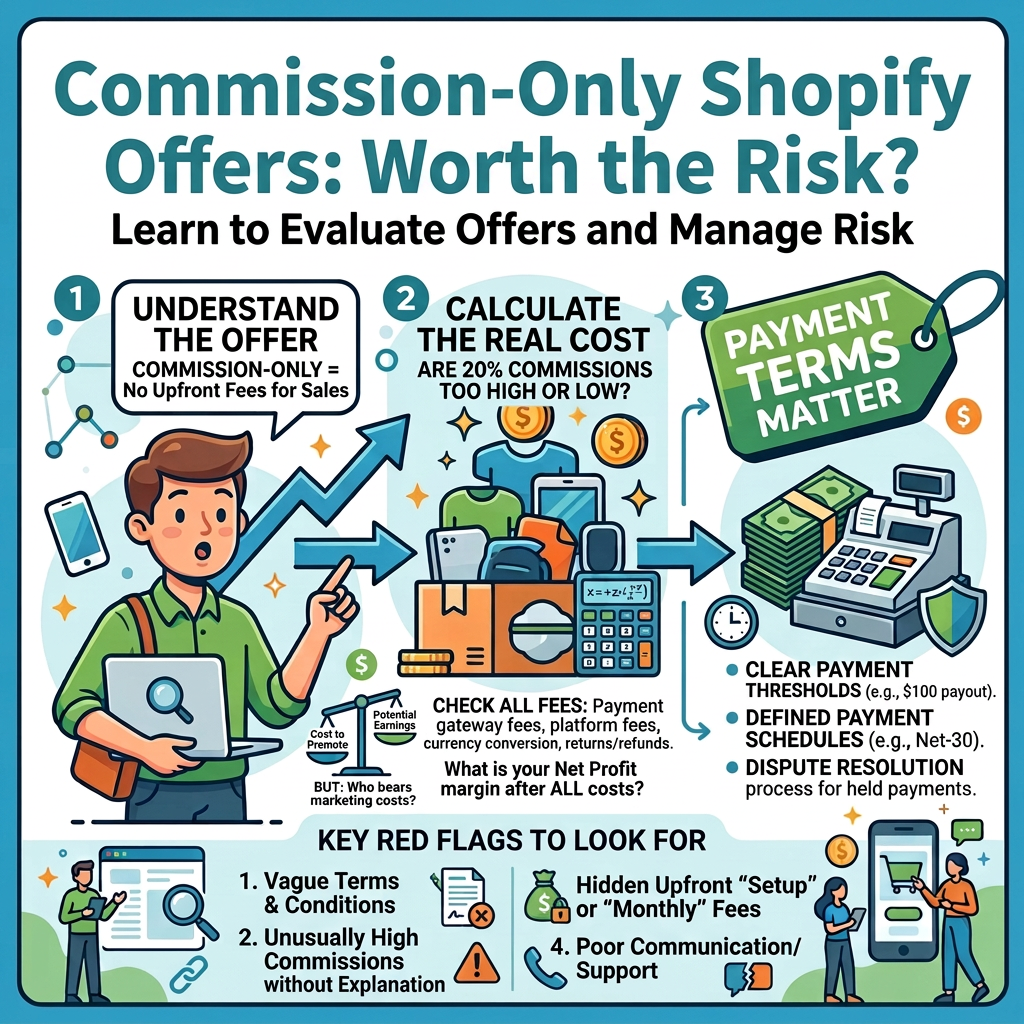
Commission-only Shopify offers are cold pitches from people who say they can bring customers to a store and earn a percentage of the resulting sales. The pitch can sound low risk: no fixed fee, no payment unless they get results.
That promise leaves out important questions. What counts as a result? How will you know the marketer caused the sale? Does the commission apply to the order total or the profit left after costs? Who pays for advertising, software, discounts, and refunds?
The examples reviewed for this post include bold sales claims, quick requests to continue on WhatsApp, and at least one mention of buying marketing tools. One message began with what looked like an ordinary customer question about international delivery. Only after the store answered did the sender switch to an offer to increase traffic and sales for a commission.
That opening can mislead the recipient about why the person got in touch. A genuine shopper usually wants information about a product, delivery, or an order. When a supposed customer question turns into a sales pitch, the first message may have been a way to start a conversation rather than a real purchase inquiry. This is deceptive outreach. The screenshot shows the switch in purpose; by itself, it does not prove the sender intended to steal money or commit another crime.
The other details still deserve scrutiny. A cold email, a misleading opening, or an ambitious promise alone does not prove fraud. Treat the offer as unverified until the person can explain the work, evidence, costs, and terms.
Why do they want to move the conversation to WhatsApp?
Several pitches quickly try to move the discussion from email to WhatsApp. The screenshots show the request, but they do not tell us why each sender made it. A private messaging app can make rapid, informal back-and-forth easier. That may make it easier for a salesperson to keep someone engaged, answer objections in real time, and build pressure to decide before the store owner has checked the claims. The shift can also take the discussion away from the original email thread, where the initial pitch and context are easy to review together.
Those are risks of the channel and the pace, not proof of intent. WhatsApp is a legitimate messaging service, and a request to use it alone does not make a pitch fraudulent. Still, there is no need to move quickly. Ask for the scope, evidence, costs, and commission terms in writing, and keep any hiring discussion and payment on the freelance marketplace if you choose to use one. If someone insists on switching apps before answering basic questions, treat that as another reason to pause.
A reply can confirm that your store email is active
There is another reason to be cautious about responding. When a store owner replies, the sender learns that the address reaches a real person who reads and answers messages. That can make the address more useful for future sales pitches. It may also be shared or used for other unsolicited messages, including scams or phishing attempts.
The screenshots show replies followed by continued outreach, but they do not reveal whether an address was added to a list or shared with anyone else. So treat list-building as a possible privacy risk, not a proven fact about these senders. A customer-style opening makes this concern more relevant because it can encourage a reply before the sales purpose becomes clear. Pretending to be an interested customer already speaks loud about the quality of the services the sender wishes to provide.
If you do reply, keep it brief and do not share order details, account information, passwords, verification codes, or store access. Avoid clicking links or opening attachments just to learn who contacted you. If the message is unwanted, mark it as spam and block the sender through your email provider. For a business contact address, consider using a dedicated inbox and reviewing where it is published publicly.
Why a “no upfront fee” offer can still cost you
A commission is a payment. For commission-only Shopify offers, the question is what the percentage applies to.
If it applies to gross sales, the marketer may receive a cut before you subtract the cost of the product, shipping, payment fees, advertising, discounts, and returns. As a result, a rate that sounds small can consume a large share of the money your store actually keeps.
Consider this made-up example. It is only an illustration; replace every figure with your own costs before making a decision.
Example for 10 attributed orders
Amount
Sales: 10 orders at $60 each
$600
Product costs
−$240
Shipping and fulfilment
−$60
Payment fees, estimated at 3% of sales
−$18
Advertising and discounts
−$120
Allowance for refunds and returns
−$30
Contribution before commission, fixed costs, and tax
$132
Now compare possible commission terms:
Commission basis
Commission paid
Contribution left before fixed costs and tax
5% of $600 gross sales
$30
$102
10% of $600 gross sales
$60
$72
20% of $600 gross sales
$120
$12
10% of $132 contribution
$13.20
$118.80
In this example, a 10% commission on sales takes $60, or about 45% of the $132 contribution. A 20% commission on sales leaves only $12 before fixed costs and tax. By contrast, 10% of contribution is $13.20. The same percentage produces very different results because the calculation uses a different base.
This is why “I only want 10%” is not enough information. Ask whether the percentage applies to gross sales, net sales, or profit, and define exactly how each number is calculated. The example also does not include your time, subscriptions, business overhead, or taxes, so your final profit may be lower.
* Financial figures are illustrative assumptions, not a forecast or advice about the store’s actual margins.
Questions to answer before agreeing to commission-only Shopify offers
Ask the person to put the full proposal in writing. It should explain:
What work will you do? For example, will you create ads, contact potential customers, improve product pages, or run an affiliate campaign?
What evidence supports your claims? Request relevant examples and explain how the results were measured. A screenshot of sales without context does not show that the marketer caused them.
What counts as an attributed sale? Define tracking method, attribution window, existing customers, repeat orders, cancelled orders, refunds, chargebacks, discounts, shipping, and taxes.
What is the commission calculated on? Write down the exact formula. Prefer a clearly defined amount after refunds and agreed costs over an undefined percentage of “revenue.”
Who pays extra costs? Ask about ad spend, apps, mailing lists, subscriptions, samples, and discounts. Do not buy a tool just because an unsolicited sender recommends it; check that the tool and cost are necessary yourself.
How can either side end the arrangement? Set a trial period, spending limit, reporting schedule, and end date. Decide what happens to pending commissions after termination.
What access do you need? Start with no store access. If access becomes necessary, use the smallest permissions needed and remove them when the work ends.
Never share your Shopify password (!)
A marketer does not need your password or login details to discuss a commission deal. Never send them by email, WhatsApp, or any other message. If store access is genuinely needed, use Shopify’s official collaborator or staff access controls, grant only the permissions required, and remove access when the work ends. A request for your password is a reason to stop the conversation.
If the person pretends to be a shopper and then reveals a sales pitch, take that as a trust warning. A quick request to move to WhatsApp is another reason to slow down and keep the claims in writing. If they also avoid clear answers, pressure you to act quickly, guarantee a large result without showing a method, or change the deal after you ask for written terms, walk away.
Use a platform contract if you hire them
If you decide to test the service, ask for a Fiverr or Upwork profile and create the order or contract through the platform itself. A profile link can help you review work history, but it does not protect a payment made directly to the person. Keep the contract, agreed scope, messages, and payments on the platform, and check its current rules before you start.
The safeguards have limits. Fiverr’s refund guidance says an order must be cancelled before a client can request a refund to the original payment method; cancelled funds may first go to the Fiverr balance. Upwork says refund requests for released payments depend on the freelancer or agency approving them, while fixed-price funds still held in escrow follow a separate process. So a marketplace gives you documented steps to request a refund or raise a dispute in some situations. It does not promise that every payment will be returned if the work disappoints you or the provider disappears.
For a first project, use a small, clearly scoped milestone with a specific deliverable, such as an audit or a campaign plan. Review that work before funding another milestone. Do not send money by bank transfer, gift card, cryptocurrency, or a separate payment link outside the platform.
Commission-based work can be reasonable when the seller has healthy margins, the work produces sales that you can track, and both sides agree on the calculation in advance. It is a poor fit when your margins are thin, sales attribution is unclear, or the marketer expects commission on customers who would have bought anyway.
Before saying yes, calculate the commission using your own figures. Include product cost, fulfilment, transaction fees, ad spend, discounts, refunds, and any tool or service fee. Then compare what remains with the time and risk involved. If you cannot tell whether the deal is profitable from the written terms, you do not have enough information to accept it.
Key takeaways
A message that begins like a customer inquiry and turns into a sales pitch may be misleading, even though that pattern alone does not prove fraud.
Replying confirms that your address is active; later use or sharing is possible, but these screenshots do not prove it happened.
A quick WhatsApp request can move the exchange into fast, informal conversation; it is a reason to slow down, not proof of a scam.
“Commission-only” does not mean “no cost”; it means the cost depends on the commission formula and the sales it covers.
A commission on gross sales can take a substantial share of the profit left after expenses.
A big revenue promise is a claim to verify, not proof that the sender can deliver.
Marketplace profiles and on-platform contracts improve documentation and may provide refund or dispute routes, but outcomes depend on the platform’s terms and the case.
A small, measurable trial is safer than giving broad access or agreeing to an open-ended share of store revenue.
A repeatable checklist for commission pitches
Save the original message and check the sender and claims without opening unexpected links or attachments.
If a supposed customer changes the conversation into a sales pitch, note the mismatch and do not share store information just to keep the conversation going.
Remember that a reply confirms your address is active; do not respond unless you have a reason to continue.
If they quickly request WhatsApp, slow the conversation down and ask for the proposal and terms in writing.
Ask for the person’s marketplace profile, relevant examples, and a written scope.
Verify the commission formula with a worked example using your own margins.
List every extra cost and decide who approves it.
Define tracking, refunds, attribution, duration, and how to end the agreement.
Start with a small on-platform milestone and limited access.
Stop if the person pushes you to pay or communicate outside the agreed platform, or will not put the terms in writing.
Bellow example emails collection:
Stay Safe With EmailClarity
Unsolicited sales pitches are not all the same. Some may be ordinary cold marketing; others may open with a misleading customer-like question before revealing a sales pitch, push for a quick move to WhatsApp, make unsupported promises, or try to move you into a risky payment arrangement. A reply also confirms that your address is active, which could lead to more unwanted messages. Check the evidence and the terms before you decide.


Leave a Reply